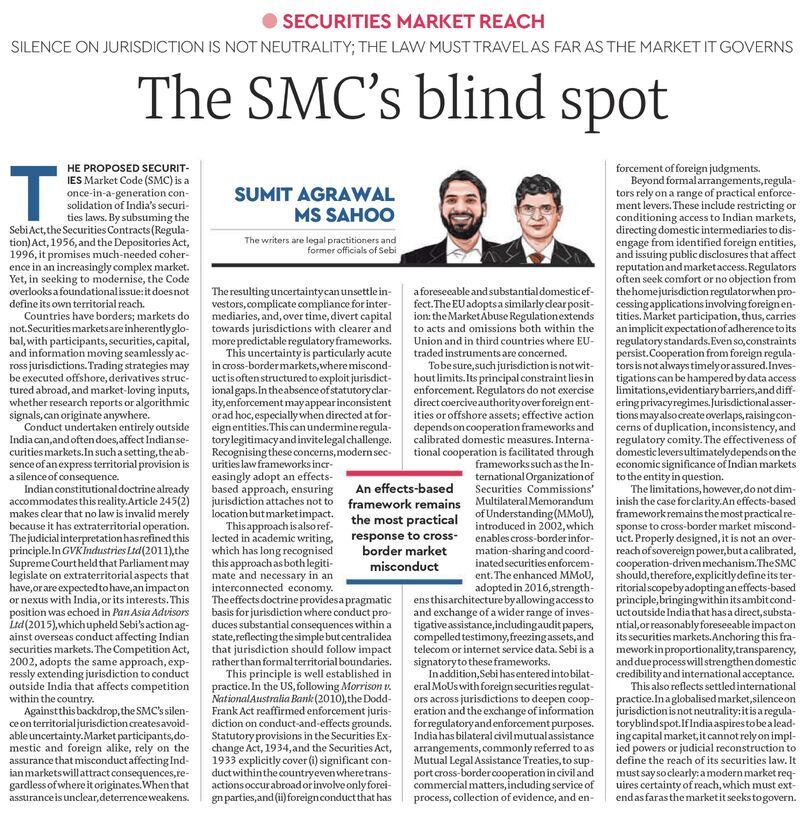
𝐓𝐡𝐞 𝐒𝐌𝐂’𝐬 𝐁𝐥𝐢𝐧𝐝 𝐒𝐩𝐨𝐭
We are pleased to share this thought-provoking article written by Dr. M. S. Sahoo and our Founder & Managing Partner, Mr. Sumit Agrawal, published in The Financial Express.
As India’s securities law framework moves towards consolidation through the proposed Securities Market Code, questions relating to territorial jurisdiction, regulatory reach and cross-border market conduct assume increasing significance. The article examines why an effects-based jurisdictional framework may be essential for a modern securities law regime.
M. S. Sahoo
Sumit Agrawal
Regstreet Law Advisors
𝐓𝐡𝐞 𝐒𝐌𝐂’𝐬 𝐁𝐥𝐢𝐧𝐝 𝐒𝐩𝐨𝐭: 𝐇𝐨𝐰 𝐟𝐚𝐫 𝐬𝐡𝐨𝐮𝐥𝐝 𝐈𝐧𝐝𝐢𝐚’𝐬 𝐬𝐞𝐜𝐮𝐫𝐢𝐭𝐢𝐞𝐬 𝐥𝐚𝐰 𝐫𝐞𝐚𝐜𝐡?
Delighted to share my article in The Financial Express, co-authored with Dr. M. S. Sahoo available at : https://lnkd.in/gfWCJrxH
The proposed Securities Market Code is a landmark consolidation of India’s securities laws. It seeks to bring coherence to a framework currently spread across the SEBI Act, SCRA and Depositories Act. But one foundational issue deserves closer attention: territorial jurisdiction.
Markets do not stop at national borders. Securities, capital, information, trading strategies, algorithms, offshore structures and market conduct often move seamlessly across jurisdictions. Conduct undertaken outside India can still affect Indian securities markets in a direct and material way.
Our argument is that the SMC should say this expressly.
India should adopt an effects-based jurisdictional framework, bringing within the Code conduct outside India that has a direct, substantial or reasonably foreseeable impact on Indian securities markets.
This is not regulatory overreach. It is a calibrated response to the realities of global markets – supported by constitutional doctrine, Indian precedent, comparative securities law and international cooperation frameworks.
A modern securities code should not leave the reach of the law to implication, reconstruction or litigation.
In global markets, silence on jurisdiction is not neutrality. It is a regulatory blind spot.