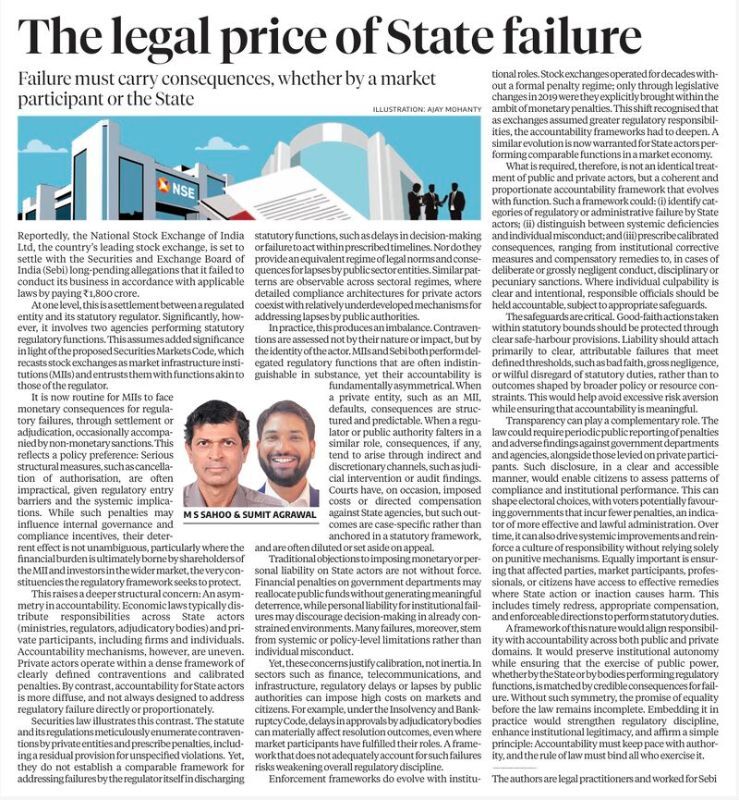
In their recent piece in Business Standard, “𝘛𝘩𝘦 𝘭𝘦𝘨𝘢𝘭 𝘱𝘳𝘪𝘤𝘦 𝘰𝘧 𝘚𝘵𝘢𝘵𝘦 𝘧𝘢𝘪𝘭𝘶𝘳𝘦”, Dr. M. S. Sahoo and Mr. Sumit Agrawal examine a fundamental asymmetry embedded within modern regulatory systems: while private market participants operate under clearly defined frameworks of liability and penalties, comparable accountability mechanisms for State actors and regulators remain fragmented, indirect, and often underdeveloped.
Using the ongoing NSE India settlement as a starting point, the authors explore how Market Infrastructure Institutions (MIIs) today perform increasingly significant regulatory and quasi-public functions. Yet, when such institutions fail, consequences are immediate, structured, and enforceable. By contrast, failures by regulators or public authorities performing similar statutory functions are often addressed only through diffuse mechanisms such as judicial criticism, audit observations, or delayed institutional correction.
The article becomes particularly relevant in the context of the proposed Securities Markets Code, which further deepens the regulatory character of stock exchanges and other MIIs. As authority expands across institutions, the authors argue that accountability frameworks must evolve in parallel.
Importantly, the piece does not advocate identical treatment of public and private actors. Instead, it calls for a calibrated and proportionate framework that distinguishes between systemic limitations, good-faith regulatory action, and clear instances of bad faith, gross negligence, or wilful disregard of statutory duties.
What makes the article compelling is the larger constitutional and institutional question it raises: can the rule of law remain complete if accountability depends more on the identity of the actor than on the nature of the failure itself?
The authors suggest that transparency, enforceable remedies, institutional corrective measures, and carefully designed safeguards could together help create a more balanced accountability architecture, one where responsibility and consequences evolve together.
Readers are also encouraged to share their views at info@regstreetlaw.com.