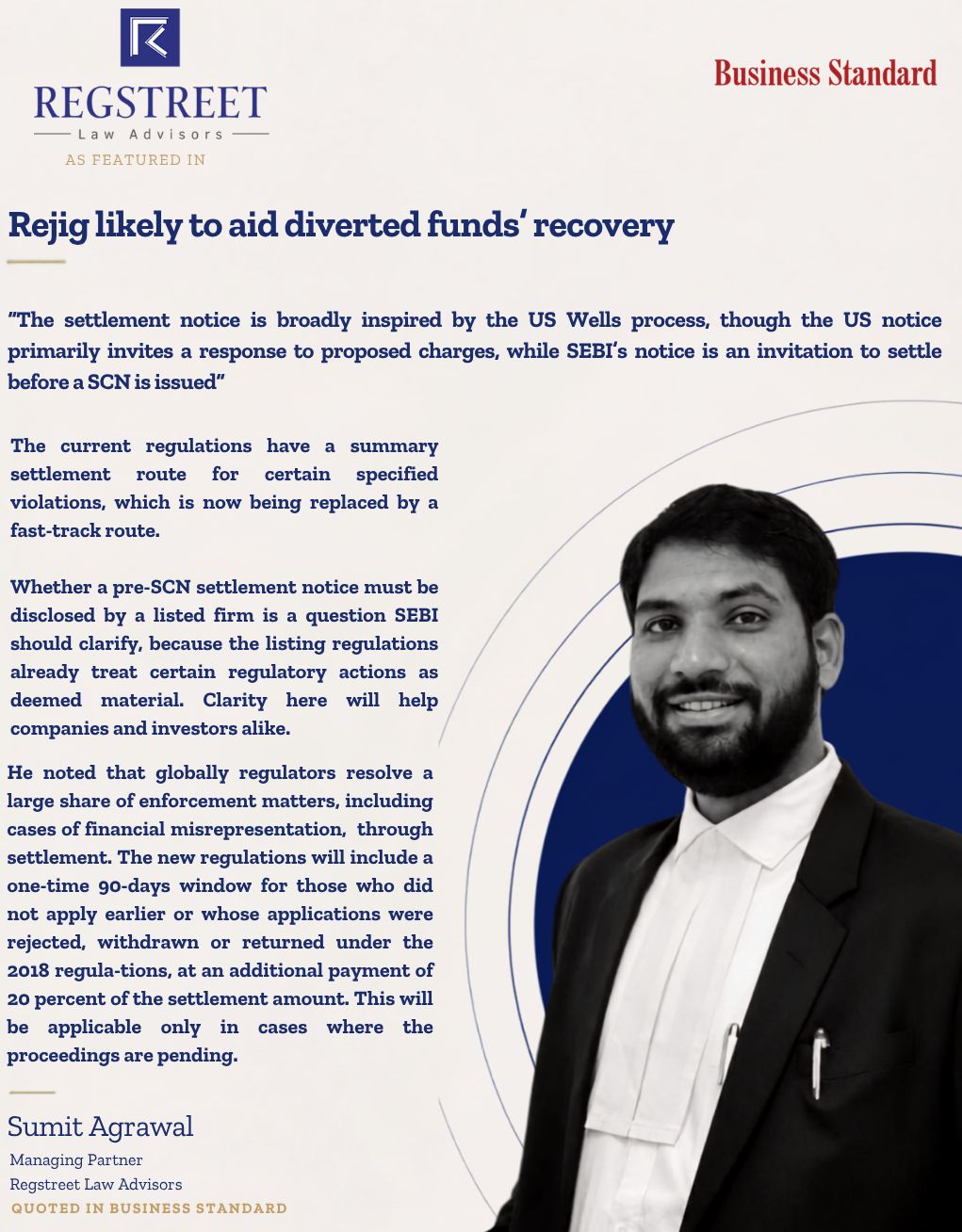
𝐒𝐄𝐁𝐈’s 𝐬𝐞𝐭𝐭𝐥𝐞𝐦𝐞𝐧𝐭 𝐧𝐨𝐫𝐦𝐬 𝐨𝐯𝐞𝐫𝐡𝐚𝐮𝐥: 𝐑𝐞𝐣𝐢𝐠 𝐥𝐢𝐤𝐞𝐥𝐲 𝐭𝐨 𝐚𝐢𝐝 𝐝𝐢𝐯𝐞𝐫𝐭𝐞𝐝 𝐟𝐮𝐧𝐝𝐬’ 𝐫𝐞𝐜𝐨𝐯𝐞𝐫𝐲
The Securities and Exchange Board of India (SEBI) is set to overhaul its settlement framework with changes aimed at enabling faster resolution of enforcement proceedings, improving recovery in cases involving wrongful gains or diverted funds, and streamlining the settlement process.
The proposed framework introduces, among other changes, a pre-SCN settlement mechanism, a fast-track route for certain specified violations, separate treatment of wrongful gains and settlement amounts, and a one-time 90-day window for certain applicants whose earlier settlement applications were rejected, withdrawn or returned under the 2018 regulations.
In this context, Mr. Sumit Agrawal, Founder & Managing Partner, Regstreet Law Advisors and former SEBI Officer, was quoted by Business Standard in its article titled “Rejig likely to aid diverted funds’ recovery”.
Mr. Sumit Agrawal observed that the proposed settlement notice is broadly inspired by the US Wells process. However, while a Wells notice primarily gives a person an opportunity to respond to proposed enforcement charges, SEBI’s proposed notice would operate as an invitation to settle before a formal show-cause notice is issued.
He further noted that the present regulations provide a summary settlement route for certain specified violations, which is proposed to be replaced by a fast-track mechanism.
Mr. Agrawal also highlighted an important disclosure issue for listed entities: whether receipt of a pre-SCN settlement notice would itself require disclosure under the listing regulations. Since certain regulatory actions are already treated as deemed material under the SEBI (LODR) Regulations, 2015, greater clarity on the treatment of such notices would assist both listed companies and investors.
He further noted that settlement is widely used by regulators globally to resolve a significant proportion of enforcement matters, including cases involving financial misrepresentation.
The proposed changes mark a significant shift towards faster and more structured resolution of securities enforcement proceedings, while also raising important questions around disclosure obligations, procedural safeguards and the interface between settlement and ongoing regulatory proceedings.
Readers are welcome to share their views with Regstreet Law Advisors at info@regstreetlaw.com.