Regstreet Law Advisors M. S. Sahoo
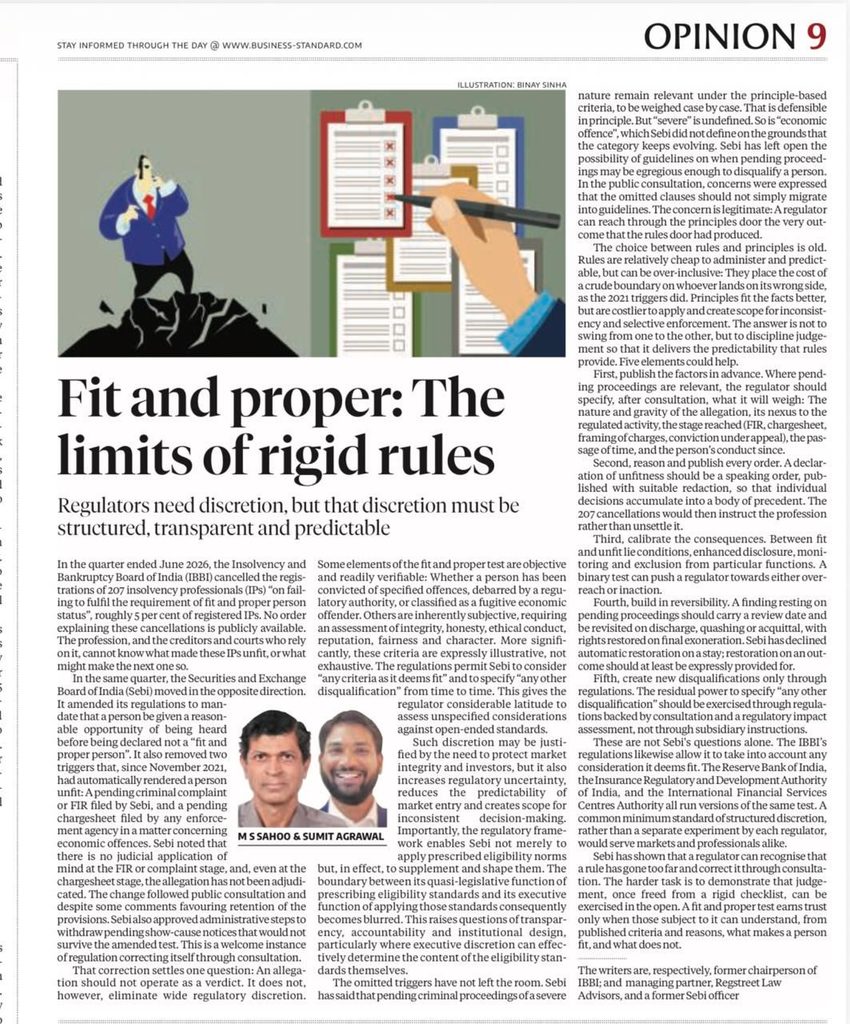
In the quarter ended June 2026, Insolvency & Bankruptcy Board of India (IBBI) cancelled the registrations of 207 insolvency professionals, about 5% of the profession, for failing the fit and proper requirement. No order explaining these cancellations is publicly available. The professionals affected, and the creditors and courts who rely on them, cannot tell what made these IPs unfit, or what might make the next one so.
In the same quarter, SEBI moved the other way. It now requires a reasonable opportunity of hearing before declaring anyone not fit and proper. It also dropped two triggers that, since November 2021, had made a person automatically unfit: a pending complaint or FIR filed by SEBI, and a pending chargesheet in an economic offence matter. It also moved to withdraw show-cause notices that would not survive the amended test. This is a welcome correction through consultation.
Wide discretion still remains. Securities and Exchange Board of India (SEBI) can consider “any criteria as it deems fit” and specify “any other disqualification.” Pending proceedings of a “severe” nature remain relevant, but “severe” is undefined, and so is “economic offence.” The risk is that what left through the rules door returns through the principles door.
In our article in Business Standard today, Dr. M. S. Sahoo and I argue that the answer is not to swing between rules and principles. The answer is to discipline judgement.We propose five safeguards:
(1) 𝐏𝐮𝐛𝐥𝐢𝐬𝐡 𝐭𝐡𝐞 𝐚𝐬𝐬𝐞𝐬𝐬𝐦𝐞𝐧𝐭 𝐟𝐚𝐜𝐭𝐨𝐫𝐬 𝐢𝐧 𝐚𝐝𝐯𝐚𝐧𝐜𝐞
(2) 𝐆𝐢𝐯𝐞 𝐫𝐞𝐚𝐬𝐨𝐧𝐬 𝐟𝐨𝐫 𝐞𝐯𝐞𝐫𝐲 𝐨𝐫𝐝𝐞𝐫 𝐚𝐧𝐝 𝐩𝐮𝐛𝐥𝐢𝐬𝐡 𝐢𝐭
(3) 𝐂𝐚𝐥𝐢𝐛𝐫𝐚𝐭𝐞 𝐜𝐨𝐧𝐬𝐞𝐪𝐮𝐞𝐧𝐜𝐞𝐬 𝐛𝐞𝐭𝐰𝐞𝐞𝐧 𝐟𝐢𝐭 𝐚𝐧𝐝 𝐮𝐧𝐟𝐢𝐭
(4) 𝐁𝐮𝐢𝐥𝐝 𝐢𝐧 𝐫𝐞𝐯𝐞𝐫𝐬𝐢𝐛𝐢𝐥𝐢𝐭𝐲 𝐨𝐧 𝐝𝐢𝐬𝐜𝐡𝐚𝐫𝐠𝐞 𝐨𝐫 𝐚𝐜𝐪𝐮𝐢𝐭𝐭𝐚𝐥
(5) 𝐂𝐫𝐞𝐚𝐭𝐞 𝐧𝐞𝐰 𝐝𝐢𝐬𝐪𝐮𝐚𝐥𝐢𝐟𝐢𝐜𝐚𝐭𝐢𝐨𝐧𝐬 𝐨𝐧𝐥𝐲 𝐭𝐡𝐫𝐨𝐮𝐠𝐡 𝐫𝐞𝐠𝐮𝐥𝐚𝐭𝐢𝐨𝐧𝐬, 𝐚𝐟𝐭𝐞𝐫 𝐜𝐨𝐧𝐬𝐮𝐥𝐭𝐚𝐭𝐢𝐨𝐧 𝐚𝐧𝐝 𝐢𝐦𝐩𝐚𝐜𝐭 𝐚𝐬𝐬𝐞𝐬𝐬𝐦𝐞𝐧𝐭
Reserve Bank of India (RBI), Insurance Regulatory and Development Authority of India, International Financial Services Centres Authority and Insolvency & Bankruptcy Board of India (IBBI) all run versions of the same test. A common minimum standard of structured discretion would serve markets and professionals alike.
A fit and proper test earns trust only when those subject to it can understand what makes a person fit, and what does not.
Read here: https://lnkd.in/giv_8VBf