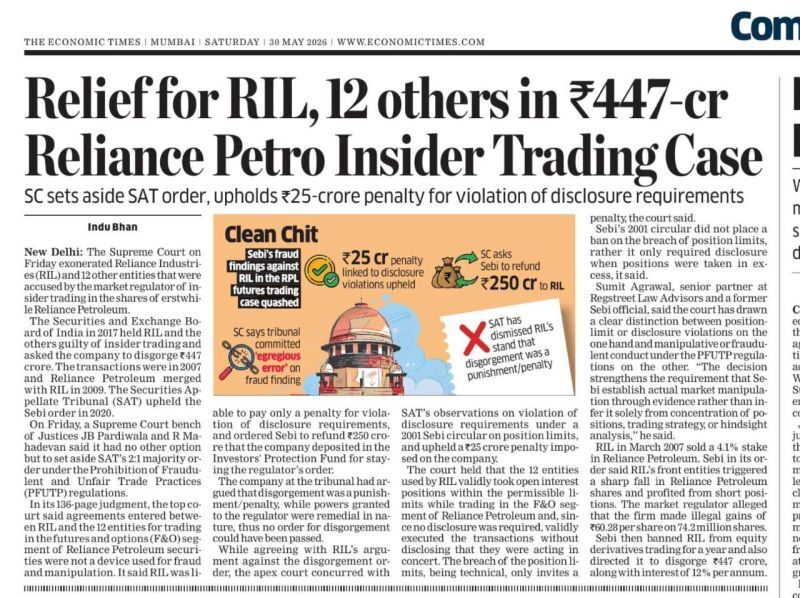
𝐒𝐮𝐩𝐫𝐞𝐦𝐞 𝐂𝐨𝐮𝐫𝐭 𝐝𝐫𝐚𝐰𝐬 𝐜𝐥𝐞𝐚𝐫 𝐥𝐢𝐧𝐞 𝐛𝐞𝐭𝐰𝐞𝐞𝐧 𝐌𝐚𝐫𝐤𝐞𝐭 𝐌𝐚𝐧𝐢𝐩𝐮𝐥𝐚𝐭𝐢𝐨𝐧 𝐚𝐧𝐝 𝐃𝐢𝐬𝐜𝐥𝐨𝐬𝐮𝐫𝐞 𝐯𝐢𝐨𝐥𝐚𝐭𝐢𝐨𝐧𝐬 𝐢𝐧 𝐑𝐞𝐥𝐢𝐚𝐧𝐜𝐞 𝐈𝐧𝐝𝐮𝐬𝐭𝐫𝐢𝐞𝐬 𝐂𝐚𝐬𝐞
In a significant judgment concerning one of India’s most closely watched securities enforcement matters, hon’ble Supreme Court of India has set aside findings of fraudulent and manipulative conduct against Reliance Industries Limited (RIL) and 12 other entities in the long-running Reliance Petroleum derivatives trading case.
In this context, Mr. Sumit Agrawal, Senior Partner, Regstreet Law Advisors and former Securities and Exchange Board of India (SEBI) Officer, has been quoted in The Economic Times article titled “𝘙𝘦𝘭𝘪𝘦𝘧 𝘧𝘰𝘳 𝘙𝘐𝘓, 12 𝘰𝘵𝘩𝘦𝘳𝘴 𝘪𝘯 ₹447-𝘤𝘳 𝘙𝘦𝘭𝘪𝘢𝘯𝘤𝘦 𝘗𝘦𝘵𝘳𝘰 𝘐𝘯𝘴𝘪𝘥𝘦𝘳 𝘛𝘳𝘢𝘥𝘪𝘯𝘨 𝘊𝘢𝘴𝘦” highlighting the broader regulatory significance of the judgment.
Mr. Agrawal observed that the Court has drawn a clear distinction between position-limit or disclosure violations on the one hand and manipulative or fraudulent conduct under the PFUTP framework on the other.
He noted that:
“𝘛𝘩𝘦 𝘥𝘦𝘤𝘪𝘴𝘪𝘰𝘯 𝘴𝘵𝘳𝘦𝘯𝘨𝘵𝘩𝘦𝘯𝘴 𝘵𝘩𝘦 𝘳𝘦𝘲𝘶𝘪𝘳𝘦𝘮𝘦𝘯𝘵 𝘵𝘩𝘢𝘵 𝘚𝘌𝘉𝘐 𝘦𝘴𝘵𝘢𝘣𝘭𝘪𝘴𝘩 𝘢𝘤𝘵𝘶𝘢𝘭 𝘮𝘢𝘳𝘬𝘦𝘵 𝘮𝘢𝘯𝘪𝘱𝘶𝘭𝘢𝘵𝘪𝘰𝘯 𝘵𝘩𝘳𝘰𝘶𝘨𝘩 𝘦𝘷𝘪𝘥𝘦𝘯𝘤𝘦 𝘳𝘢𝘵𝘩𝘦𝘳 𝘵𝘩𝘢𝘯 𝘪𝘯𝘧𝘦𝘳 𝘪𝘵 𝘴𝘰𝘭𝘦𝘭𝘺 𝘧𝘳𝘰𝘮 𝘤𝘰𝘯𝘤𝘦𝘯𝘵𝘳𝘢𝘵𝘪𝘰𝘯 𝘰𝘧 𝘱𝘰𝘴𝘪𝘵𝘪𝘰𝘯𝘴, 𝘵𝘳𝘢𝘥𝘪𝘯𝘨 𝘴𝘵𝘳𝘢𝘵𝘦𝘨𝘺, 𝘰𝘳 𝘩𝘪𝘯𝘥𝘴𝘪𝘨𝘩𝘵 𝘢𝘯𝘢𝘭𝘺𝘴𝘪𝘴.”
The ruling is likely to be closely examined by market participants, compliance professionals and enforcement practitioners, particularly for its treatment of the evidentiary threshold required to establish fraud and manipulation in the securities market, as distinct from technical or disclosure-related breaches.
Readers are welcome to share their views at info@regstreetlaw.com.
A copy of the news article is attached herewith.