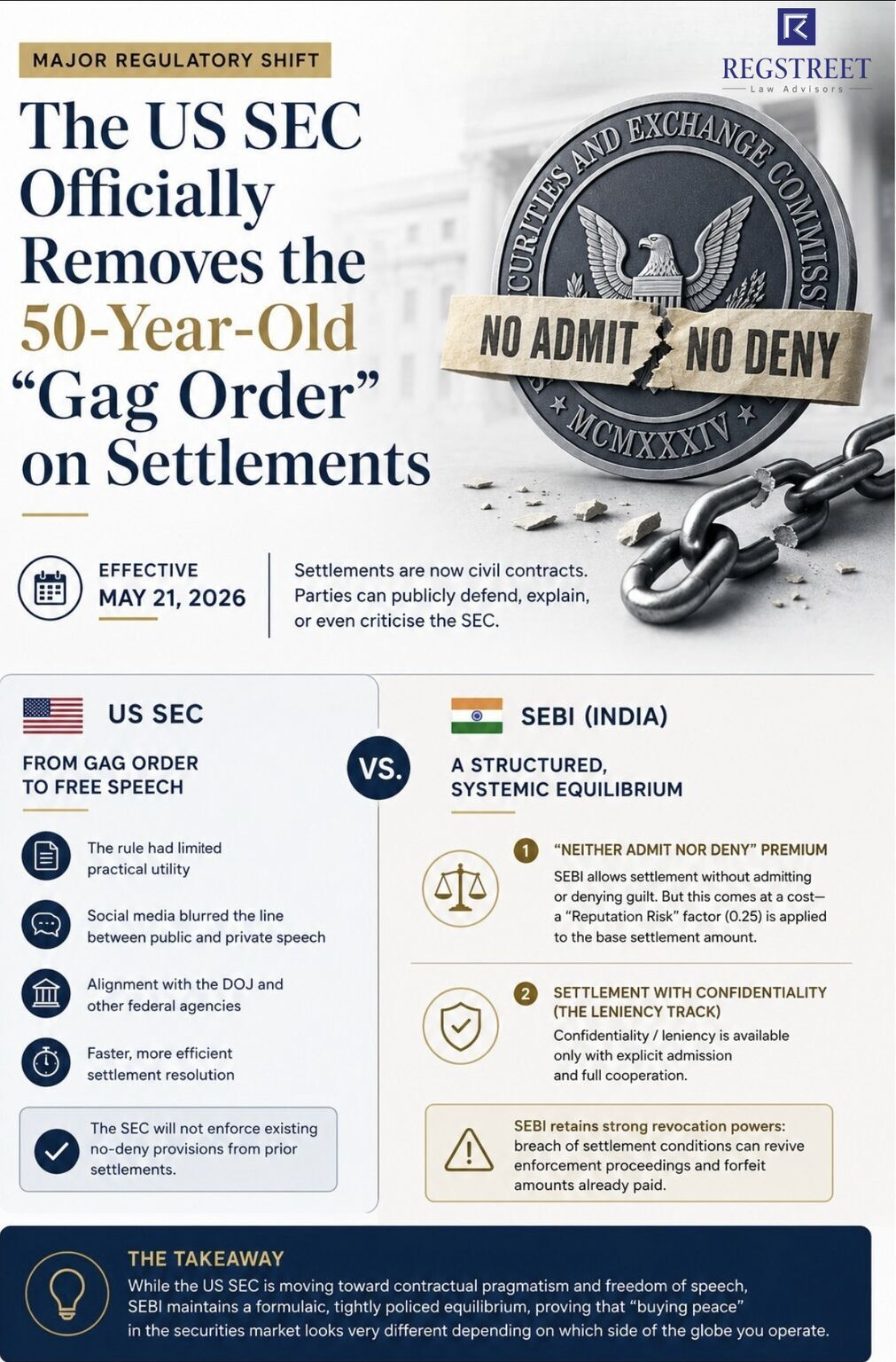
𝗠𝗮𝗷𝗼𝗿 𝗥𝗲𝗴𝘂𝗹𝗮𝘁𝗼𝗿𝘆 𝗦𝗵𝗶𝗳𝘁: 𝗧𝗵𝗲 𝗨𝗦 𝗦𝗘𝗖 𝗢𝗳𝗳𝗶𝗰𝗶𝗮𝗹𝗹𝘆 𝗥𝗲𝗺𝗼𝘃𝗲𝘀 𝘁𝗵𝗲 𝟱𝟬-𝗬𝗲𝗮𝗿-𝗢𝗹𝗱 “𝗚𝗮𝗴 𝗢𝗿𝗱𝗲𝗿” 𝗼𝗻 𝗦𝗲𝘁𝘁𝗹𝗲𝗺𝗲𝗻𝘁𝘀
In a monumental policy reversal, the U.S. Securities and Exchange Commission has officially rescinded its long-standing “no admit / no deny” rule (Rule 202.5(e)). The press release is accessible here: https://lnkd.in/dHx9KCAN
Since 1972, parties settling SEC enforcement actions without admitting guilt were barred from publicly denying the allegations or challenging the SEC’s factual basis.
Effective May 21, 2026, that changes. The SEC will now treat settlements as civil contracts, allowing parties to publicly defend their reputation, provide context, or even criticise the agency’s theories after settlement.
The SEC cited 4 key reasons for this deregulation: 1. The rule had limited practical utility 2. Social media blurred the line between public and private speech 3. Alignment with the U.S. Department of Justice and other federal agencies 4. Faster, more efficient settlement resolution
Importantly, the SEC also stated it will not enforce existing no-deny provisions from prior settlements.
A major contrast can be seen in India’s regulatory approach.
As the US SEC steps away from policing post-settlement speech, the Securities and Exchange Board of India (SEBI) approaches the “Admission of Fault” dynamic through a highly structured, systemic framework.
The SEBI (Settlement Proceedings) Regulations, 2018 has a dual-track model:
1. The “Neither Admit Nor Deny” Premium: SEBI allows entities to settle without admitting or denying guilt. However, it explicitly prices this privilege. Under SEBI’s mathematical calculation schedule, an applicant must apply a “Reputation Risk” factor multiplier (0.25) to their base settlement amount if they choose not to admit to the violations.
2. Settlement with Confidentiality (The Leniency Track): Chapter IX of SEBI’s regulations offers a formal track for immunity or leniency. But Confidentiality / leniency is available only with explicit admission and full cooperation.
The Takeaway: While the US SEC is moving toward contractual pragmatism and freedom of speech, SEBI maintains a formulaic, tightly policed equilibrium, proving that “buying peace” in the securities market looks very different depending on which side of the globe you operate.
For a deeper perspective on SEBI’s evolving settlement architecture, readers may also refer to a recent article co-authored by our Managing Partner, Mr. Sumit Agrawal, and Dr. M. S. Sahoo on reimagining SEBI’s consent settlement framework. The same is accessible here: https://lnkd.in/dpZ-RKWn
Readers may share their thoughts on info@regstreetlaw.com.
Sumit Agrawal Kavish Garach Akarsh Tripathi Aditi Sahu