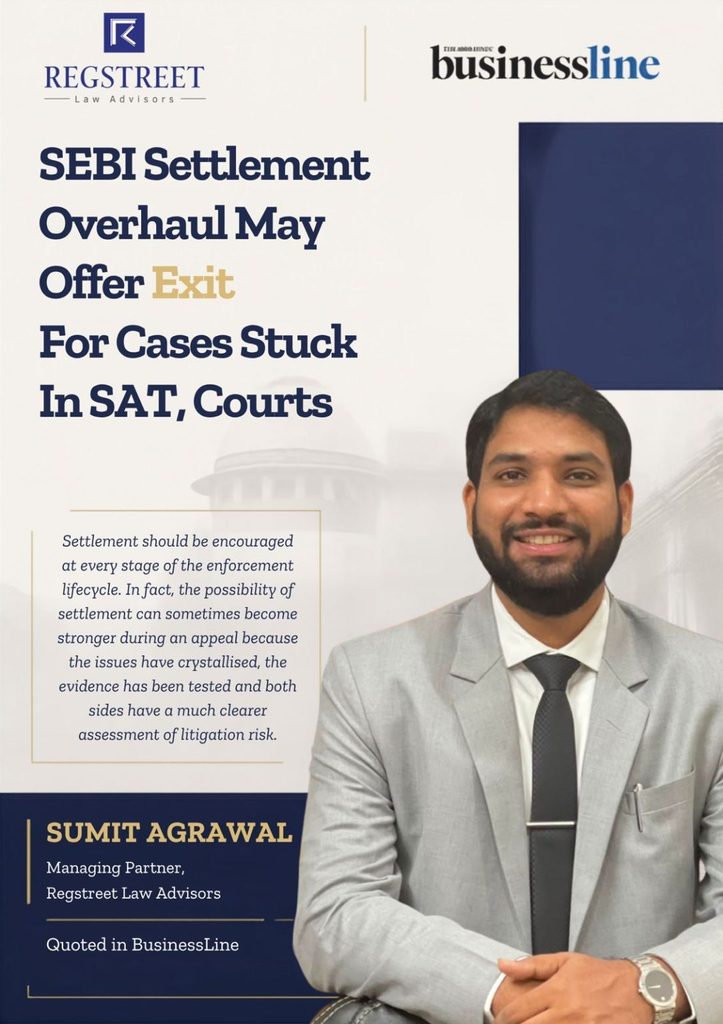
𝐒𝐄𝐁𝐈 𝐒𝐞𝐭𝐭𝐥𝐞𝐦𝐞𝐧𝐭 𝐎𝐯𝐞𝐫𝐡𝐚𝐮𝐥 𝐌𝐚𝐲 𝐎𝐟𝐟𝐞𝐫 𝐄𝐱𝐢𝐭 𝐟𝐨𝐫 𝐂𝐚𝐬𝐞𝐬 𝐒𝐭𝐮𝐜𝐤 𝐢𝐧 𝐒𝐀𝐓, 𝐂𝐨𝐮𝐫𝐭𝐬
The Securities and Exchange Board of India (SEBI)’s proposed overhaul of its settlement framework could open a wider route for parties to resolve enforcement matters that have already reached the Securities Appellate Tribunal (SAT) or the Supreme Court of India, addressing a long-pending backlog of cases at the appellate stage. Among the key changes, SEBI has proposed removing the existing 60-day limitation that currently closes the settlement window early in the enforcement process, keeping it open even after proceedings reach SAT or the Supreme Court.
In this context, Mr. Sumit Agrawal, Managing Partner, Regstreet Law Advisors, was quoted by businessline. He observed that settlement should be encouraged at every stage of the enforcement lifecycle.
According to Mr. Agrawal, the possibility of settlement can sometimes become stronger during an appeal, since by that stage the issues have crystallised, the evidence has been tested, and both sides have a much clearer assessment of litigation risk.
The proposed changes could therefore offer a meaningful route to resolution for the significant backlog of matters currently pending before SAT and the Supreme Court, including 1,066 appeals before Securities Appellate Tribunal and 539 cases before the Supreme Court of India.
𝐑𝐞𝐚𝐝 𝐭𝐡𝐞 𝐟𝐮𝐥𝐥 𝐚𝐫𝐭𝐢𝐜𝐥𝐞 𝐚𝐭 𝘉𝘶𝘴𝘪𝘯𝘦𝘴𝘴𝘭𝘪𝘯𝘦: https://lnkd.in/gDt5wxU7
Readers are welcome to share their views with Regstreet Law Advisors on info@regstreetlaw.com.
#Regstreet #SEBI #SAT #SecuritiesLaw #RegulatoryLaw #CapitalMarkets