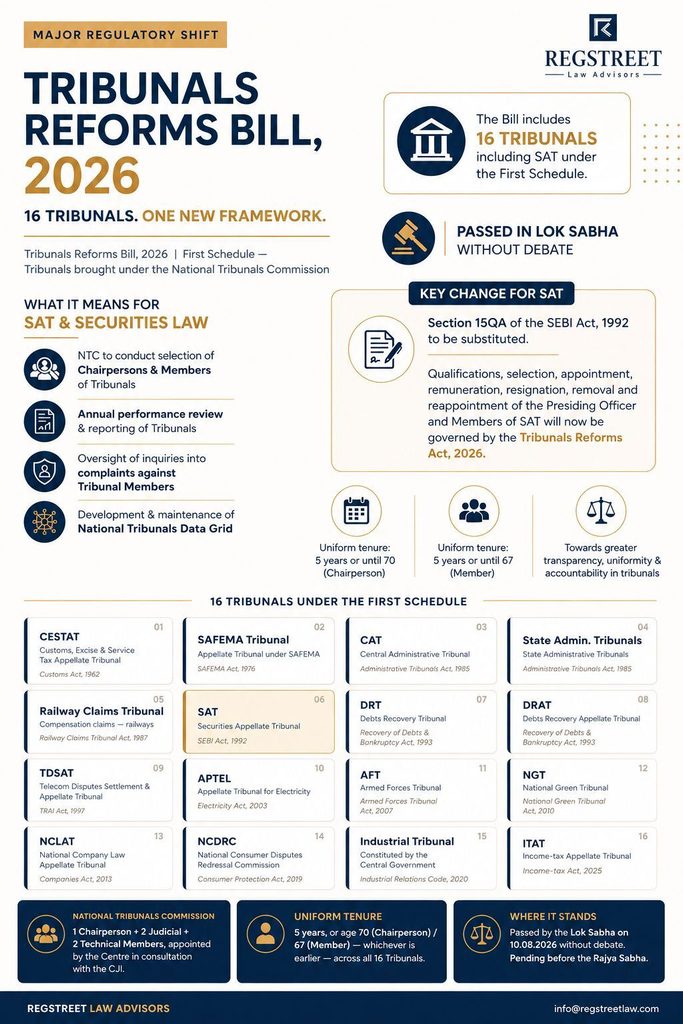
𝐓𝐫𝐢𝐛𝐮𝐧𝐚𝐥𝐬 𝐑𝐞𝐟𝐨𝐫𝐦𝐬 𝐁𝐢𝐥𝐥, 2026: 𝐖𝐡𝐚𝐭 𝐈𝐭 𝐌𝐞𝐚𝐧𝐬 𝐟𝐨𝐫 𝐒𝐀𝐓 𝐚𝐧𝐝 𝐒𝐞𝐜𝐮𝐫𝐢𝐭𝐢𝐞𝐬 𝐋𝐚𝐰
The Lok Sabha passed the Tribunals Reforms Bill, 2026, on 10 August 2026, amid Opposition protests and without debate. The Bill now awaits consideration and passage by the Rajya Sabha, and Presidential assent, before it comes into force. It seeks to replace the Tribunals Reforms Act, 2021, and establish a National Tribunals Commission (NTC) as the central institutional framework for the appointment, administration and oversight of tribunals.
For securities-law practitioners, the Bill has a particularly important implication – the Hon’ble Securities Appellate Tribunal (SAT) will now come within this new framework. The Bill brings all 16 𝐓𝐫𝐢𝐛𝐮𝐧𝐚𝐥𝐬 𝐮𝐧𝐝𝐞𝐫 𝐢𝐭𝐬 𝐅𝐢𝐫𝐬𝐭 𝐒𝐜𝐡𝐞𝐝𝐮𝐥𝐞 within the NTC’s ambit: 𝐂𝐄𝐒𝐓𝐀𝐓, 𝐭𝐡𝐞 𝐒𝐀𝐅𝐄𝐌𝐀 𝐀𝐩𝐩𝐞𝐥𝐥𝐚𝐭𝐞 𝐓𝐫𝐢𝐛𝐮𝐧𝐚𝐥, 𝐂𝐀𝐓, 𝐒𝐭𝐚𝐭𝐞 𝐀𝐝𝐦𝐢𝐧𝐢𝐬𝐭𝐫𝐚𝐭𝐢𝐯𝐞 𝐓𝐫𝐢𝐛𝐮𝐧𝐚𝐥𝐬 (𝐒𝐀𝐓𝐬), 𝐭𝐡𝐞 𝐑𝐚𝐢𝐥𝐰𝐚𝐲 𝐂𝐥𝐚𝐢𝐦𝐬 𝐓𝐫𝐢𝐛𝐮𝐧𝐚𝐥 (𝐑𝐂𝐓), 𝐒𝐀𝐓, 𝐃𝐑𝐓, 𝐃𝐑𝐀𝐓, 𝐓𝐃𝐒𝐀𝐓, 𝐀𝐏𝐓𝐄𝐋, 𝐀𝐅𝐓, 𝐍𝐆𝐓, 𝐍𝐂𝐋𝐀𝐓, 𝐍𝐂𝐃𝐑𝐂, 𝐭𝐡𝐞 𝐈𝐧𝐝𝐮𝐬𝐭𝐫𝐢𝐚𝐥 𝐓𝐫𝐢𝐛𝐮𝐧𝐚𝐥 (𝐂𝐞𝐧𝐭𝐫𝐚𝐥 𝐆𝐨𝐯𝐞𝐫𝐧𝐦𝐞𝐧𝐭), 𝐚𝐧𝐝 𝐈𝐓𝐀𝐓.
Section 4 of the Bill assigns the NTC four key functions: conducting the selection process for Chairpersons and Members of tribunals; reviewing tribunal performance and preparing annual reports; overseeing inquiries into complaints against tribunal members; and developing and maintaining a National Tribunals Data Grid.
The Bill also proposes to substitute Section 15QA of the SEBI Act, 1992.Consequently, the qualifications, selection, appointment, remuneration, resignation, removal and reappointment of the Presiding Officer and Members of SAT will be governed by the proposed Tribunals Reforms Act, rather than the Securities and Exchange Board of India (SEBI) Act’s existing framework.
This is a significant structural shift. The Bill seeks greater uniformity in tribunal administration, with Chairpersons serving five years or until 70, and Members five years or until 67.
The Bill follows the Hon’ble Supreme Court’s ruling in 𝐌𝐚𝐝𝐫𝐚𝐬 𝐁𝐚𝐫 𝐀𝐬𝐬𝐨𝐜𝐢𝐚𝐭𝐢𝐨𝐧 𝐯. 𝐔𝐧𝐢𝐨𝐧 𝐨𝐟 𝐈𝐧𝐝𝐢𝐚 (2025 𝐈𝐍𝐒𝐂 1330), which struck down key provisions of the 2021 Act for violating separation of powers and judicial independence, and directed the Centre to constitute the NTC. Yet appointments to the NTC itself remain with the Central Government, albeit in consultation with the Chief Justice of India for its Chairperson and Judicial Members.
Therefore, the real measure of reform will not be merely the creation of the NTC, but whether it delivers independent appointments, continuity, institutional capacity and timely adjudication at SAT.
Readers are welcome to share their views at info@regstreetlaw.com.